Article
Yoga and Meditation
Yoga and meditation are both ancient practices. They are inextricably intertwined but let's start with Yoga.
Yoga is now an international phenomenon and if you do not practice it yourself, you surely know someone who does. As we know it today, it is a series of breathing techniques and physical postures promoted as a mode of physical fitness that can generate health and wellbeing. However, it is actually an ancient science and spiritual discipline originating in India. Its earliest purpose was not only physical fitness but to prepare the body for deep meditation and spiritual insight. A system of physical, mental and spiritual practices designed to help individuals achieve union with the divine and attain self-realisation. The word itself comes from the Sanskrit root Yuj, meaning to yoke or to unite which refers to the union of the self and universal consciousness.
The goal of Yoga is to achieve a "oneness", a state of freedom referred to as mukti, nirvana or moksha. A person who has achieved this is said to be in "yoga" and is termed a "yogi". This can then overcome all kinds of suffering and lead to a state of liberation, health and harmony.
Yoga is complex and can be hard to define exactly. Yoga's origins can be traced back thousands of years but some of the earliest writings are in the Upanishads, a collection of yogic texts dating from about 800 to 400 BC. These texts document the transition from the archaic ritualism of the Veda, the original Sanskrit texts, into the new religious concepts of Hinduism. The Yoga Sutras is one of the most famous texts on the fundamentals of Yoga and was written by Patanjali circa 300 BC to 200 AD. In this foundational text, he defines Yoga as "the cessation of the whirling fluctuations of the mind".
The cessation of thoughts is the result of a dedicated and consistent practice of Yoga. By calming our mental chatter, this contemplative practice connects us to the source of our being where we can experience the unity of our own self, as well as the unity of everything else around us. It is a meditative process of self-discovery and liberation; a way to control the mind and to let go of things that do not serve us. It can expand our consciousness and help us to connect with the universe around us, teaching us self-awareness, acceptance, compassion, patience, gratitude, forgiveness, humility, love, peace and joy.
Patanjali laid out the fundamentals of Yoga philosophy and practice in these Sutras. He describes 8 spiritual, mental and physical steps that lead us to the ultimate goal of enlightenment. They are:
- Yama - moral code of conduct
- Niyama - ethical guidelines
- Asana - proper posture
- Pranayama - proper breathing
- Pratyahara - withdrawal of senses from external distractions
- Dharana - concentration on a specific sound, image, mantra or object
- Dhyana - absorptive meditation
- Samadi - cessation of all mental activity to attain a state of oneness
Yoga, as most in the West teach it and term it today, is essentially only steps 3 and 4 here, a series of Asanas or postures together with proper breath. Each Asana is designed not only to improve flexibility but also to create space, physically in the body and emotionally, in the mind. Breath being the key to deeper connection to ourselves and to the divine. Yoga is for all ages and has many benefits: flexibility, strength, improved posture, circulation and digestion. It is especially helpful as we age when these are even more important. The postures work with the fascia (the body's connective tissue), the lymphatic system and the parasympathetic nervous system. It is the journey that matters. Mindfulness and patience are key. Everyone advances at their own pace. Even just practicing Hatha yoga one can experience a reduction in stress and anxiety, improved focus and more balanced emotions. There are many schools of Hatha Yoga, each with their own unique style and philosophy: Ashtanga, Sivananda, Iyengar and Yin to name a few.
Yoga practiced fully is not a religion but a complete philosophy of life. It offers practices that can complement various spiritual beliefs or stand alone as a secular practice aimed at personal growth and emotional well being. It can support trauma release, provide methods for deep relaxation and nervous system regulation. Yoga, in its true essence can involve confronting oneself and grappling with discomfort, fear and pain. The profound teachings of Yoga mean also sitting with your shadow side and dealing with unresolved issues. Ultimately however, it allows us to connect with our highest truth, live with intention and make choices that serve our highest good.
As mentioned above, the entire structure of Yoga supports the meditative state. Most especially, Pratyahara and Dharana are preparative, leading to Dyana and then ultimately to Samadi. However, there are many other forms of meditation that do not follow the Yogic tradition. Here are some examples:
Vipassana
This is essentially a Buddhist practice with Vipassana centres all over the world. It involves paying close attention to the present moment without judgement. The aim is not to empty the mind but to become aware of what is already happening within it. It means "to see things as they really are". It is a simple, practical way to achieve real peace of mind through self-observation.
Metta
Metta meditation is also called loving-kindness meditation. Its aim is compassion, beginning with oneself and gradually extending to others. It is a heart-opening practice that has been shown to reduce stress, increase empathy and improve emotional resilience through repetitive phrases. Ultimately it seeks to develop unconditional positive emotions and promote well-being.
Transcendental Meditation (TM) Meditation
TM is a branded, structured practice that uses a specific, personalised mantra given by a certified teacher. It is practiced twice a day for 20 minutes and has gained popularity due to its ease of use and proven benefits. It was revived by Maharishi Mahesh Yogi from a tradition that is thousands of years old. However, it has also been widely studied and has many peer reviewed scientific papers written about how it provides improved brain function, better sleep, reduced anxiety and stress and ultimately inner peace.
There are many TM centres all over the world.
Guided Visualisation
In this approach, a teacher or recording leads the meditator through a visual journey for example imagining a beautiful place in nature, light flowing through the body or the presence of a loving guide. It can be a powerful way to access relaxation, creativity and emotional healing.
Body Scan Meditation
Common in mindfulness based stress reduction (MBSR), the body scan involves systematically moving one's attention through the body, noticing sensations without trying to change anything. It is excellent for grounding and can reveal where we hold unconscious tension or even trauma. This can be led by a practitioner or done by oneself.
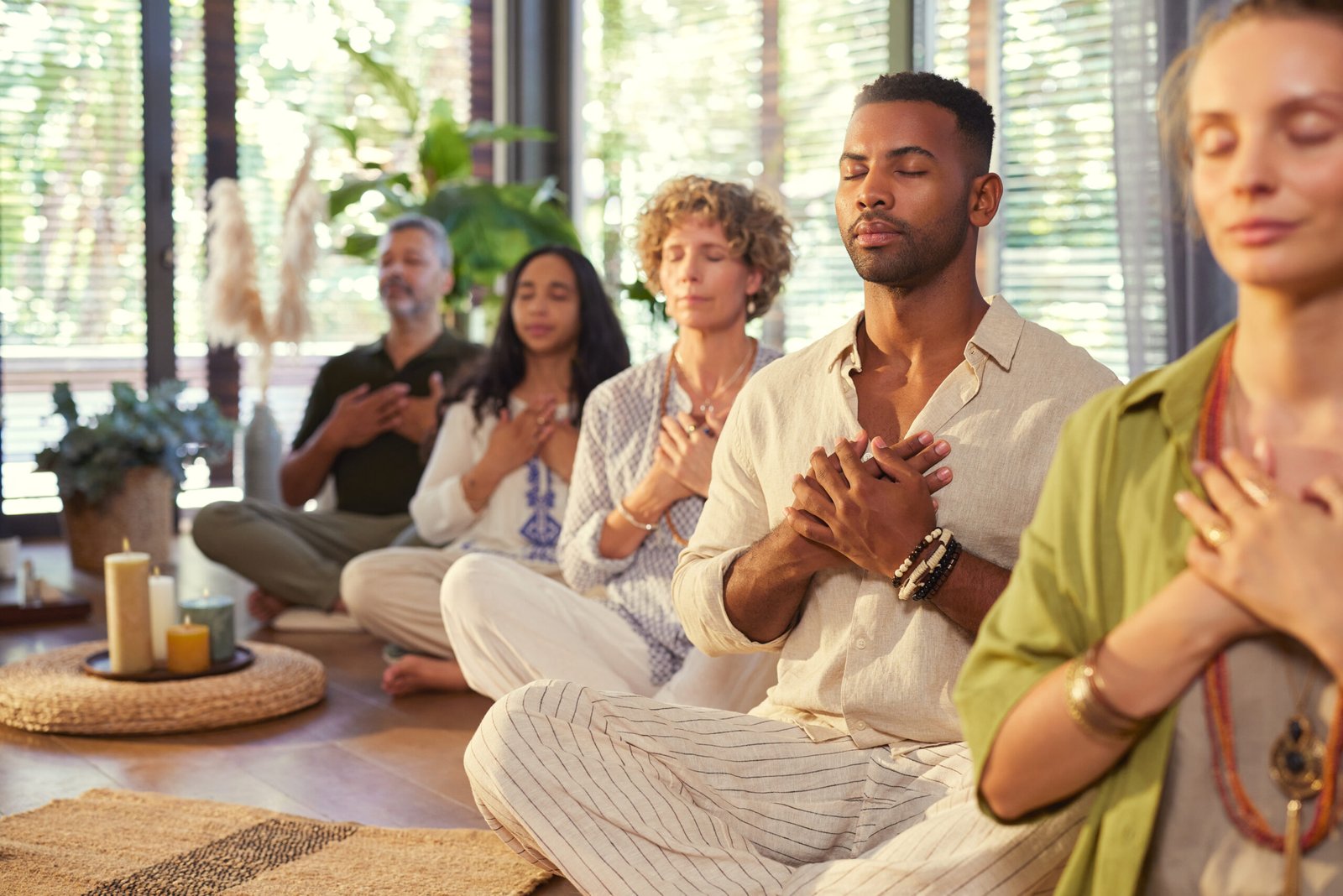
Most meditation is in silence however, there are many other forms of meditative practice, some involving sound or even movement. Whichever form of meditation you try, even just a few minutes a day can yield profound benefits. It has been shown to lower cortisol levels, improve sleep and energy levels, regulate emotions and foster a deeper sense of purpose. Meditation creates space, space between stimulus and response, between thought and action. There is no right way to meditate. Try different techniques until you find one that works for you starting with the one that you feel drawn to.
Ultimately, meditation can help us rediscover peace, shift us from doing to being.
Whether you approach meditation through the Yogic tradition or another path, it is a personal journey. It doesn't have to involve incense or sitting for hours cross-legged, it simply requires us to pause, to observe, to breathe, to be and let the overwhelm of modern life drift away. Yoga and meditation are not quick fixes. They are lifelong journeys of self-discovery. Some days, the practice flows effortlessly; other days, it may feel challenging. Whatever your experience, it provides awareness and from awareness, everything grows.